
Aging solo? The 1 form that keeps the courts out of your care
No spouse or adult child to step in? Why standard wills fail without this operational setup.
Most estate planning advice relies on a single, unspoken assumption:
When you get sick or slow down, a spouse or an adult child will automatically step in, pay your bills, speak to doctors, and manage the logistics.
For nearly 30% of Americans aged 55 and older, that assumption is flatly incorrect.
Whether you never married, are divorced, outlived your partner, or chose not to have children, you are what researchers call a Solo Ager.
Retiring solo offers extraordinary independence. You choose where to live, how to spend, and how to structure your days with zero compromises.
However, the American healthcare, legal, and financial systems were fundamentally built for couples and adult children. If you experience an unexpected hospital stay, stroke, or cognitive decline without a designated legal advocate, the court system does not guess what you wanted.
They initiate a public guardianship hearing, appoint a court-assigned conservator, and charge their hourly legal fees directly to your estate.
This week, we audit the operational infrastructure every solo ager needs to ensure personal autonomy remains in their own hands.
The Blind Spot: Why a Simple Will Protects Nothing While You Live
The most common mistake solo agers make is drafting a will and assuming the job is finished.
A will is a dead-hand document: it has zero legal power while you are alive.
If you are incapacitated in an ICU for 3 months following a car accident or dealing with temporary delirium from an infection:
- Your will cannot authorize an advocate to speak with your surgeon.
- Your will cannot pay your mortgage or manage your utility bills.
- Your will cannot access your bank accounts to ensure your dog or cat is cared for.
Without explicit, living legal proxies in place, your financial accounts freeze and your medical choices default to state hospital protocol.
The 4 Core Documents of Solo Infrastructure
To build an airtight perimeter around your care and assets, you need 4 specific legal mechanisms working in tandem:
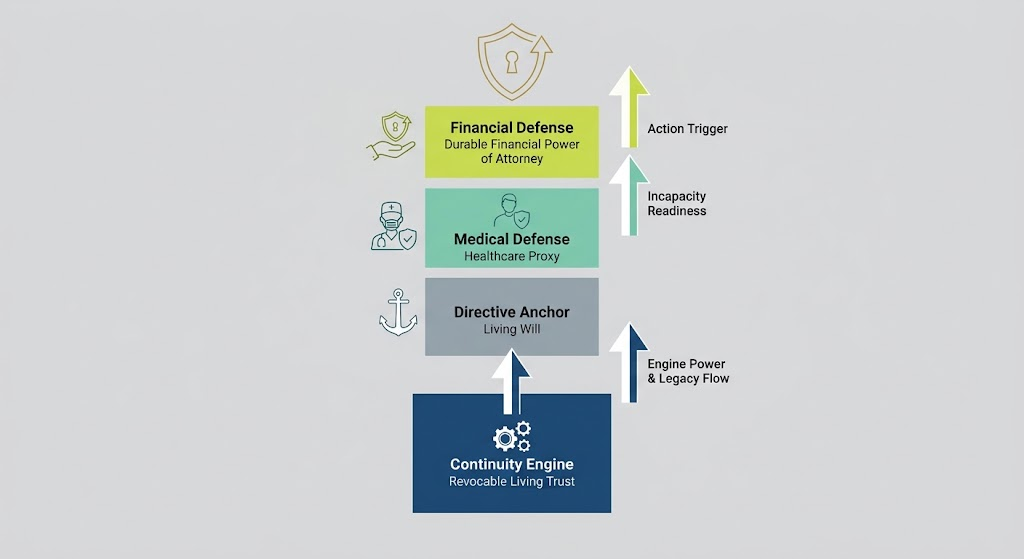
1. The Durable Financial Power of Attorney (DPOA)
A standard power of attorney terminates if you become disabled or incapacitated. A durable power of attorney remains active specifically when you lose capacity.
- Crucial Clause: Ensure your document includes explicit digital asset language. If your agent cannot legally access your online password manager, email accounts, or two-factor authentication devices, managing your bills becomes an administrative nightmare.
2. The Healthcare Proxy + HIPAA Release
This appoints an individual to make medical treatment decisions if you are physically or mentally unable to do so.
- The Gotcha: Most hospitals will refuse to speak with a friend or non-relative without a signed HIPAA Release. Keep an executed copy saved on your phone and provide a physical copy to your primary care physician to upload directly into your electronic health record.
3. The Advance Directive (Living Will)
This document removes the emotional guesswork for your proxy. It spells out your exact preferences regarding ventilators, feeding tubes, dialysis, and comfort care.
Be granular: write down your explicit definitions of acceptable quality of life (e.g., ability to recognize loved ones, independent mobility) rather than vague phrases like “do not keep me on machines.”
4. The Revocable Living Trust
For solo agers, a trust is not a vehicle for dodging taxes; it is an anti-conservatorship shield.
If you hold your brokerage accounts and real estate inside a Revocable Living Trust, you designate a Successor Trustee. If you become incapacitated, your successor trustee steps in instantly to manage trust assets without filing an emergency petition with a county probate judge.
The Big Question: Who Do You Appoint If You Have No Family?
This is where most solo agers hit decision paralysis: “I understand the documents, but whose name do I put on the line?”
If you do not have a close family member, you have three distinct avenues:
| Fiduciary Option | Best For | Pros & Cons |
|---|---|---|
| Trusted Friend or Younger Peer | Medical Proxy | Pros: Knows your personal values intimately. Cons: Emotionally taxing; peer friends may face their own health issues simultaneously. |
| Professional Fiduciary / Daily Money Manager | Financial Power of Attorney | Pros: Bound by strict legal standards; experienced in insurance/billing; carries liability coverage. Cons: Charges an hourly fee ($75 to $250/hr depending on region). |
| Corporate Trust Company / Bank | Successor Trustee | Pros: Institutional longevity (they never get sick, die, or move away). Cons: High account minimums (often $500,000+) and annual percentage fees. |
The Optimal Hybrid Model: Many successful solo setups appoint an empathetic, trusted friend as the Healthcare Proxy (to advocate for comfort and care) and hire an objective, bonded Professional Fiduciary as the Financial Power of Attorney / Successor Trustee (to handle audits, bill payments, and tax filings).
The Practical Checklist: Your Digital ICE File
Having documents locked inside a safe deposit box does no good if paramedics cannot find them at 2:00 AM on a Sunday.
Take these three operational steps this week:
- Build a “Grab File”: Print physical copies of your Healthcare Proxy, Advance Directive, and a 1-page summary sheet listing your medications, allergies, and emergency contacts. Place it on your refrigerator door in a red folder (first responders are trained to look there).
- Set up Medical ID on Your Phone: Configure the emergency health profile on your smartphone (Apple Health or Android Medical ID). This allows emergency personnel to see your primary proxy’s phone number without unlocking your device.
- Register with a Digital Registry: Services like DocuBank or MedicAlert store your directives digitally, providing you with an emergency wallet card that emergency rooms can scan to retrieve your documents instantly.
Your Action Item for This Week
- Check your existing estate documents: do you have a signed Durable Financial Power of Attorney and a Healthcare Proxy, or only a traditional will?
- If your documents are more than 5 years old, confirm that the individuals you designated are still able and willing to act on your behalf.
- If you lack a clear candidate for financial agent, search the National Guardian Association (NGA) or American Association of Daily Money Managers (AADMM) directory for a licensed, bonded professional fiduciary in your area.