
The RMD tax avalanche (why waiting until 75 backfires)
SECURE 2.0 pushed mandatory distributions to 73 and 75. Leaving money untouched turns into a forced tax bomb.
When Congress passed the SECURE 2.0 Act and pushed the Required Minimum Distribution (RMD) age back to 73—and eventually 75 for anyone born in 1960 or later—the headlines celebrated it as an unqualified victory for retirees.
“Keep your money compounding tax-deferred longer! The government is letting you delay withdrawals!”
Deferring withdrawals sounds like a gift. In practice, delay is often an illusion.
Every dollar inside a traditional 401(k) or IRA is a deferred tax liability. If you leave a substantial pre-tax nest egg alone to compound into your mid-70s, the IRS does not forget about their share.
They simply wait until the compounding balance peaks, then use mandatory distribution tables to force accelerated withdrawals out of your accounts every single year—driving your income into higher tax brackets and triggering automatic surcharges across your retirement benefits.
This week, we audit the mechanics of the RMD tax avalanche and map out the Bracket-Packing Strategy to defuse the bomb between ages 58 and 72.
The Mechanics: How the IRS Divisor Works
An RMD is not a modest suggestion. It is a mandatory distribution calculated by taking your prior-year December 31 account balance and dividing it by an IRS life-expectancy divisor (from the Uniform Lifetime Table):
| Age | IRS Divisor | Effective Mandatory Withdrawal % |
|---|---|---|
| 73 | 26.5 | 3.77% |
| 75 | 24.6 | 4.07% |
| 78 | 22.0 | 4.55% |
| 82 | 18.5 | 5.41% |
| 86 | 15.2 | 6.58% |
| 90 | 12.2 | 8.20% |
(Data source: IRS Publication 590-B, Table III.)
Notice the trend: the divisor shrinks every year. By age 85, you are legally forced to liquidate over 6% of your balance each year; by age 90, more than 8%.
If your accounts continue to grow at 6% or 7% annually while you leave them untouched from age 60 to 75, that percentage is applied against an inflated asset pool.
The Anatomy of an Avalanche
Consider a 62-year-old couple with $1.8 M in combined pre-tax retirement accounts:
- They live comfortably off a pension, taxable brokerage assets, and Social Security.
- They leave their $1.8 M traditional 401(k) untouched.
- Compounding at 6.5% annually, that $1.8 M balance doubles to $4.1 M by age 75.
At age 75, the law mandates their first RMD.
- The Year 1 Mandate: $4.1 M divided by 24.6 = $166,666 of mandatory taxable income.
- That $166,666 is stacked on top of their Social Security and pension income.
- By age 82, even with withdrawals, account growth and shrinking divisors force annual distributions above $250,000.
They did not need that cash to cover daily living expenses. Yet the mandatory checks trigger a domino effect:
- Federal Tax Spikes: Pushing income into the 24% and 32% marginal brackets.
- Maximum IRMAA Penalties: Adding $3,000 to $8,000+ per year in Medicare Part B and Part D surcharges.
- The Single-Survivor Tax Trap: When 1 spouse passes away, the surviving spouse inherits the entire remaining balance. That survivor must file as a Single taxpayer—slashing standard deductions by half and compressing tax brackets—while continuing to pull the exact same six-figure RMDs.
The Defense: Bracket-Packing in the “Golden Gap”
The time to defuse this tax bomb is not at age 74. It is during the Golden Gap: the window between the day you retire (often ages 58 to 65) and the year mandatory RMDs kick in (age 73 or 75).
During these years, your earned income drops to $0, and you control your taxable baseline.
Instead of showing zero taxable income, you intentionally pack your brackets through structured annual Roth conversions:
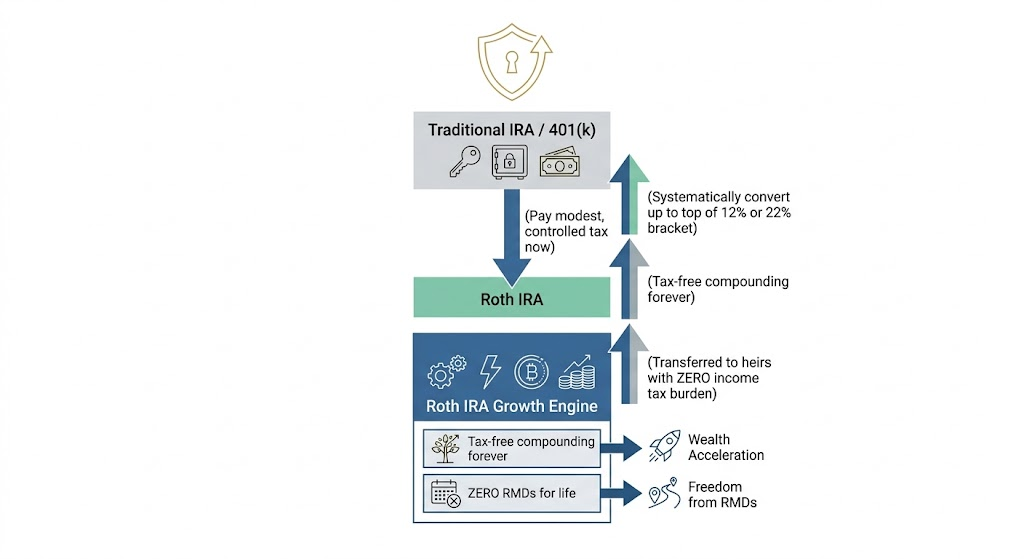
Step 1: Identify Your Target Ceiling
Look at the taxable bracket boundaries. For married couples filing jointly:
- The 12% bracket absorbs taxable income up to $100,800.
- The 22% bracket absorbs taxable income up to $211,400.
If your living expenses are funded through cash savings or return-of-basis brokerage accounts, convert $50,000 to $120,000 each year, deliberately filling the 12% or 22% bracket to its edge.
Step 2: Coordinate with IRMAA and ACA Rules
- Ages 58 to 64: If you use ACA health exchange plans, prioritize keeping MAGI below 400% FPL ($62,600 single / $85,000 joint) to keep your health subsidies. Run moderate conversions or pause until age 65.
- Ages 63 to 72: Watch the 2-year IRMAA look-back. Plan conversions so your total MAGI stays just below the primary IRMAA cliff ($106,000 single / $212,000 joint).
Step 3: The QCD Lever at 70½
Even though RMDs now start at 73 or 75, Qualified Charitable Distributions (QCDs) become legal at age 70½.
If you are charitably inclined, you can donate up to $111,000 per year directly from your traditional IRA to a qualified 501(c)(3) non-profit. The money transfers directly without hitting your adjusted gross income, quietly shrinking the balance before RMD formulas take over.
The Inherited IRA Reality (The SECURE Act 10-Year Clock)
Before 2020, children who inherited a traditional IRA could “stretch” withdrawals over their own lifetimes.
Today, under the 10-year rule, non-spouse beneficiaries must empty the entire account within 10 years of your death.
If your children inherit a $1.5 M traditional IRA during their peak earning years (ages 45 to 55), forcing them to withdraw $150,000+ a year on top of their corporate salaries pushes their marginal tax rate past 40% to 50% (federal plus state).
By packing your lower brackets at 12% or 22% today, you convert that money into a Roth IRA that passes to your heirs completely income-tax-free.
Your Action Item for This Week
- Add up the current pre-tax balances across all traditional 401(k)s, 403(b)s, and traditional IRAs.
- Estimate your age 73 or 75 balance by applying a 5% to 6% annual growth rate between your current age and your RMD starting year.
- Divide that estimated balance by 25.
If that estimated annual check is larger than your actual living expenses, talk to your CPA about establishing a multi-year bracket-packing conversion plan before December 31.
Next week: The Post-Retirement Umbrella Policy. Most retirees hold $300,000 in auto and homeowner liability coverage—leaving their homes, pensions, and taxable accounts completely exposed to catastrophic lawsuits. We audit how a $250 annual policy protects a lifetime of savings.