
The HSA secret weapon (and the 6-month Medicare penalty)
Why an HSA beats a Roth IRA – until an automatic Medicare rule triggers a 6% IRS penalty.
Most employees treat a Health Savings Account (HSA) like a flexible spending account with better marketing: money goes in pre-tax, sits in cash, and gets spent on dental checkups, prescription glasses, or specialist copays.
If you have other cash to cover routine doctor visits, using an HSA that way misuses the single most tax-efficient account in the Internal Revenue Code.
An HSA is the only financial vehicle that offers a triple tax advantage:
- Tax-deductible contributions going in (exempt from federal, state, and FICA payroll taxes when contributed through payroll).
- 100% tax-free investment growth while compounding.
- 100% tax-free withdrawals for qualified medical expenses.
Neither a traditional 401(k) nor a Roth IRA offers that three-way tax shield.
Yet, as you cross past age 60, this tax shelter hides a quiet regulatory landmine. If you work past 65 and delay Medicare, an automatic, retroactive Social Security rule can backdate your enrollment and hit your HSA with IRS excise penalties.
This week, we audit how to run the “Shoebox Strategy” before retirement—and how to disarm the Medicare 6-month look-back trap.
Phase 1: The Shoebox Strategy (The Shadow IRA)
The real power of an HSA lies in one sentence buried in IRS Publication 969: There is no statutory deadline for reimbursing yourself for a qualified medical expense.
As long as the medical expense occurred after you formally established your HSA, you can pay that bill with out-of-pocket cash today, retain the receipt, and reimburse yourself 5, 10, or 25 years down the road.
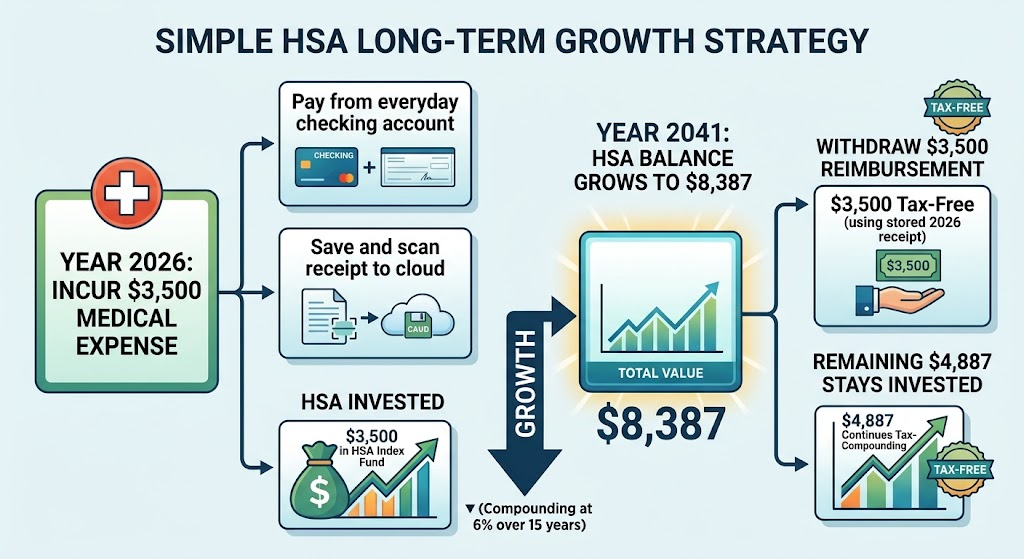
While that $3,500 sits untouched inside your HSA, you invest it in broad-market index funds.
Decades later in retirement, when you need cash to buy a car, take a trip, or cover home repairs, you pull that $3,500 out of your HSA completely tax-free by matching it against your saved 2026 receipt.
What Happens at Age 65?
If you reach age 65 and find yourself with more HSA money than medical receipts, the account automatically converts its withdrawal rules:
- The standard 20% non-medical withdrawal penalty disappears completely.
- You can withdraw funds for any non-medical purpose, paying ordinary income tax on the distribution—functioning identically to a traditional IRA.
- Unlike a traditional 401(k) or IRA, an HSA never forces Required Minimum Distributions (RMDs).
The 2026 Contribution Ceilings
For 2026, the IRS caps HSA contributions at:
- $4,400 for self-only coverage under an eligible High-Deductible Health Plan (HDHP).
- $8,750 for family coverage.
- $1,000 Catch-Up: Individuals aged 55 and older can contribute an additional $1,000. (If both spouses are 55+, each spouse must hold their own separate HSA account to capture both $1,000 catch-up allowances.)
Phase 2: The Trap (The 6-Month Retroactive Look-Back)
Here is where older workers run into costly trouble.
To contribute to an HSA, federal law requires that you have no disqualifying health coverage. Enrolling in any part of Medicare instantly disqualifies you from making new HSA deposits.
If you retire at 65 and enroll in Medicare, the solution is simple: stop HSA contributions the month before your 65th birthday.
The disaster strikes those who work past 65:
- You work until age 67 at a company with 20+ employees.
- You maintain employer HDHP coverage and continue maxing out your HSA.
- In October of your 67th year, you retire and apply for Social Security or Medicare Part A.
Here is the regulatory hammer: when you apply for Medicare Part A (or Social Security) after age 65, the federal government automatically backdates your Part A coverage by 6 months (or back to your 65th birthday, whichever is shorter).
Because your Part A coverage is legally deemed active 6 months before your application date, you were technically enrolled in Medicare during that entire half-year period.
Every HSA dollar you—and your employer—contributed during those 6 months is immediately classified by the IRS as an excess contribution:
- The contributions are added back to your taxable gross income.
- The IRS levies a 6% excise tax penalty on those excess funds every single year until they are corrected and removed.
The Playbook: How to Disarm the Trap
If you plan to work past 65 with an HSA:
1. Stop contributions 6 months before you touch the system
If you plan to retire or apply for Medicare/Social Security on November 1, adjust your payroll elections with HR to stop all HSA contributions on May 1.
2. Prorate your annual contribution ceiling
The IRS limits your annual contribution based on the months you were eligible. If your Medicare Part A is backdated to July 1, you can only contribute 6/12ths of your 2026 annual maximum. If you contributed the full $5,400 individual max in the first 5 months of the year, you have excess contributions that must be resolved.
3. The Emergency Fix: Form “Removal of Excess”
If you already triggered retroactive Part A while funding an HSA, do not wait for the IRS to send an audit notice.
- Contact your HSA custodian immediately and request a Removal of Excess Contributions form.
- As long as you pull out the excess funds (plus any investment earnings they generated) before your tax filing deadline (including extensions), you avoid the recurring 6% excise penalty.
What You Can Spend HSA Dollars on After 65
Even though new contributions must stop, your existing HSA balance remains 100% spendable.
Once on Medicare, you can use your accumulated HSA reserves completely tax-free for:
- Medicare Part B monthly premiums.
- Medicare Part D prescription drug premiums.
- Medicare Advantage (Part C) plan premiums.
- Dental cleanings, crowns, dentures, and implants.
- Hearing aids, exams, and batteries.
- Eyeglasses, contacts, and vision surgeries.
- Qualified long-term care insurance premiums (up to annual IRS age-based limits).
(Note: Medigap supplemental premiums do not qualify as an eligible HSA expense.)
Your Action Item for This Week
- If you are 55 or older with an HSA, confirm whether your account is sitting 100% in cash or invested in low-cost index funds.
- Create a dedicated folder in Google Drive, Dropbox, or a fireproof file box labeled “HSA Unreimbursed Receipts” to track out-of-pocket medical bills paid with personal cash.
- If you are 64 and plan to work past 65 with an HSA-eligible plan, set a reminder on your calendar exactly 6 months before your intended retirement date to dial your HSA payroll deduction down to $0.
Next week: The RMD Tax Avalanche. Required Minimum Distributions start at age 73 or 75, but the time to defuse them is in your late 50s and early 60s. We audit the “bracket-packing” framework to drain pre-tax accounts before the IRS forces your hand.