
The first 3 years can make or break your retirement
Why a 20% drop at age 62 destroys wealth faster than a 40% crash at age 45.
During your working years, a 25% stock market drop is an inconvenience. You keep earning a salary, reinvest dividends, and scoop up index funds at a discount. A bear market actually accelerates your wealth accumulation.
The day you stop working and begin liquidating assets to pay your mortgage and buy groceries, that mathematical rule flips on its head.
When you enter the drawdown phase, an early market downturn is no longer a temporary fluctuation. It becomes a structural threat known as Sequence of Returns Risk.
If the market drops sharply during the first three to five years of your retirement, continuing to sell falling assets to cover living costs can permanently cut the lifespan of your nest egg—even if the market recovers later.
This week, we audit the math behind this drawdown trap and build a practical Cash Buffer Architecture to insulate your balance sheet.
The Mathematics: Average Returns Are an Illusion
Standard retirement planning often relies on a fatal assumption: the “average return.”
Consider two retirees, Retiree A and Retiree B. Both start at age 62 with a $1,000,000 portfolio and withdraw a baseline $50,000 each year (a standard 5% initial rate), adjusted by 3% annually for inflation.
Both portfolios experience the exact same average annual return of +6% over a 25-year period. The only difference is the order in which those returns occur:
- Retiree A experiences three difficult years immediately upon retiring (-15%, -12%, -8%), followed by twenty-two years of strong bull-market growth.
- Retiree B experiences three strong years up front (+20%, +15%, +12%), with the downturn occurring two decades later.
Because Retiree A was forced to liquidate depressed equities to extract $50,000 checks, their portfolio suffered from reverse compounding. By the time the recovery arrived, there were too few shares left to benefit from the rebound.
The result: Retiree A runs completely out of money by age 77. Retiree B ends up with over $1,800,000 at age 87.
Same average return. Totally opposite outcome.
Why Dollar-Cost Selling Destroys Capital
When you accumulate wealth, you use dollar-cost averaging: your fixed paycheck buys more shares when prices are down.
When you retire without a cash cushion, you engage in dollar-cost selling:
- If your index shares trade at $100, you liquidate 500 shares to generate $50,000.
- If a market contraction drops that share price to $70, you must liquidate 714 shares to generate that exact same $50,000.
Those extra 214 liquidated shares are permanently erased from your balance sheet. They can never participate in the subsequent market recovery.
The Defense: The 3-Tier Cash Buffer Architecture
To neutralize sequence risk, you do not need to abandon equities and hold 80% bonds. You only need to build an operational buffer between your daily grocery bills and your equity portfolio.
Historical data shows that since 1950, the average S&P 500 bear market trough lasts roughly 10 to 12 months, with full market recoveries typically taking 2 to 3 years.
By structuring your capital into 3 distinct tiers, you buy the time necessary to let markets heal:
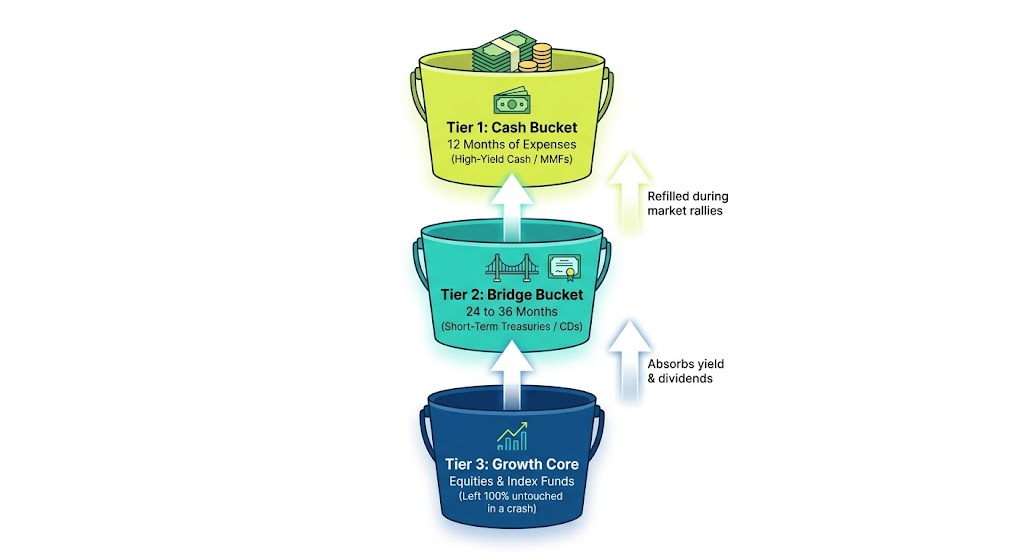
Tier 1: The Liquidity Reserve (12 Months of Net Living Needs)
- Where it sits: High-Yield Savings Accounts (HYSA) or Treasury Money Market Funds.
- The role: This is pure, unencumbered liquidity. Your monthly spending is set up as an automatic transfer from this account directly to your checking account. You never look at stock tickers to pay monthly bills.
Tier 2: The Capital Bridge (24 to 36 Months of Net Expenses)
- Where it sits: A rolling Treasury ladder, short-term fixed income, or defined-maturity bond ETFs.
- The role: Capital preservation with zero credit risk. If a multi-year downturn strikes, Tier 2 feeds Tier 1 as bonds mature at par value, guaranteeing you have 3 to 4 total years of living expenses without selling a single share of stock.
Tier 3: The Growth Engine (The Remainder)
- Where it sits: Diversified equities, broad index funds, and long-term dividend growers.
- The role: Combatting inflation over a 25- to 30-year retirement horizon. Because Tier 1 and Tier 2 provide up to 4 years of spending runway, you never become a forced seller at the bottom of a market cycle.
The Rebalancing Valve: How to Refill the Buffer
A cash buffer only functions if you have clear rules for replenishing it:
- In Bull Markets (Stocks Up): Trim Tier 3 equity gains annually to top up Tier 1 and Tier 2 back to their target ceilings.
- In Bear Markets (Stocks Down): Turn off automated portfolio rebalancing. Let portfolio dividends flow into Tier 1, and live entirely off the maturing bonds in Tier 2. You leave Tier 3 completely untouched until equities cross above their previous highs.
Your Action Item for This Week
If you plan to retire in the next 12 to 36 months:
- Calculate your Net Annual Burn Rate (Total annual living expenses minus guaranteed non-portfolio income like pensions or Social Security).
- Multiply that net burn rate by 3.
- Check your asset allocation: do you currently have that amount positioned in capital-preservation assets (cash equivalents, short Treasuries, money markets), or is it exposed to equity market fluctuations?
If your near-term spending sits exposed inside equities, start peeling off that capital during strength rather than scrambling to liquidate when a downturn hits.
Next week: The 2026 Tax Cliff Audit. The Tax Cuts and Jobs Act (TCJA) individual brackets expire at the end of next year. We audit what happens when the 12%, 22%, and 24% brackets revert to 15%, 25%, and 28%—and the exact window you have left to execute strategic conversions.