
The downsizing mirage (where did the $300,000 go?)
Selling the family house feels like an automatic cash windfall—until the friction costs eat 25%.
The napkin math of downsizing looks deceptively simple:
Sell the 4-bedroom suburban house for $750,000. Buy a tidy 2-bedroom condo or townhome for $450,000. Bank the $300,000 difference into index funds, eliminate yard work, and slash monthly living costs forever.
It is one of the most common core strategies in American retirement planning.
In practice, downsizing is rarely a 1-to-1 financial swap. Between transactional friction, property tax reassessment rules, and the current structural crisis in community association dues, moving into a smaller home can sometimes result in higher monthly carrying costs than staying right where you are.
This week, we audit the actual ledger of downsizing—and the 4 financial leaks that quietly swallow home equity.
The Balance Sheet Friction: The 10% Transaction Haircut
Before a single dollar of home equity moves into your investment account, the process of buying and selling real estate extracts a heavy administrative fee.
Consider an actual transaction ledger on a $750,000 sale and a subsequent $450,000 purchase:
| Expense Category | Typical Rate / Cost | Dollar Cost |
|---|---|---|
| Seller Real Estate Broker Commissions | 4.5% to 5.5% | $37,500 |
| Pre-Sale Prep & Repairs (Staging, paint, roof patch) | ~1.5% | $11,250 |
| Seller Transfer Taxes & Title Closing Fees | 1.0% to 2.0% | $9,000 |
| Buyer Closing Costs & Title Escrow | 1.5% to 2.5% of new home | $9,000 |
| Physical Moving Logistics & Downsizing Disposal | Flat regional rate | $5,500 |
| New Home Setup & Adjustments (Window treatments, paint, locks) | Flat baseline | $6,000 |
| Total Transaction Friction | ~10.4% of sale price | $78,250 |
That hypothetical $300,000 liquid windfall has shrunk to $221,750 before factoring in taxes or ongoing expenses.
Leak 1: The Section 121 Capital Gains Squeeze
Under IRS Section 121, you can exclude up to $250,000 in capital gains on your primary residence if single, or up to $500,000 if married filing jointly.
If you bought your home 25 or 30 years ago for $150,000 and it now sells for $750,000, your gross gain is $600,000:
- If you are married filing jointly: Your $500,000 exclusion covers most of it. You owe capital gains tax on the remaining $100,000 (plus state tax where applicable).
- If you are a surviving spouse or single filer: Your exclusion is capped at $250,000. You face $350,000 of taxable capital gains.
Even worse: that excess capital gain spikes your Adjusted Gross Income for the year, which can push you right over the 400% ACA subsidy cliff (if under 65) or trigger maximum Medicare IRMAA surcharges 2 years later (if 63+).
The Defense: Dig up every home improvement receipt from the past 25 years. Kitchen remodels, replaced HVAC units, new roofs, and landscaping additions add directly to your cost basis, cutting taxable gains dollar-for-dollar.
Leak 2: The HOA Assessment & Insurance Trap
Retirees often trade a single-family home for a condo or townhome to escape maintenance.
Instead of paying a contractor directly, you pay a Homeowners Association (HOA) board.
In recent years, aging building stock, stricter structural reserve mandates, and a volatile commercial property insurance market have hit condo associations hard.
- The Monthly Escalator: National median condo HOA assessments now frequently range from $450 to over $1,200 a month in mature developments.
- The Special Assessment Hammer: If an association underfunded its roof or elevator replacement reserves over the past 20 years, they bridge the gap with a one-time “special assessment”. Bills of $20,000 to $60,000 per unit are no longer rare edge cases.
Paying $800 a month in HOA fees is the financial equivalent of carrying an extra $120,000 of mortgage debt at current interest rates.
Leak 3: The Property Tax Reset
Many homeowners assume that moving to a house that costs 40% less automatically cuts property taxes by 40%.
That depends entirely on state tax structures:
- In states with property tax assessment caps (such as California’s Proposition 13, Florida’s Save Our Homes, or similar caps in Texas and Michigan), your long-term family home may have an assessed taxable value far below its current market value.
- If you bought your original home decades ago, you might be paying property taxes assessed on a baseline of $220,000.
- Moving into a new $450,000 condo resets the assessment to the full purchase price of $450,000.
You downsized your square footage by half, but your annual property tax bill doubled.
The Audit Framework: The Downsizing Decision Matrix
To see if a move makes mathematical sense, run your plan through this 3-part check:
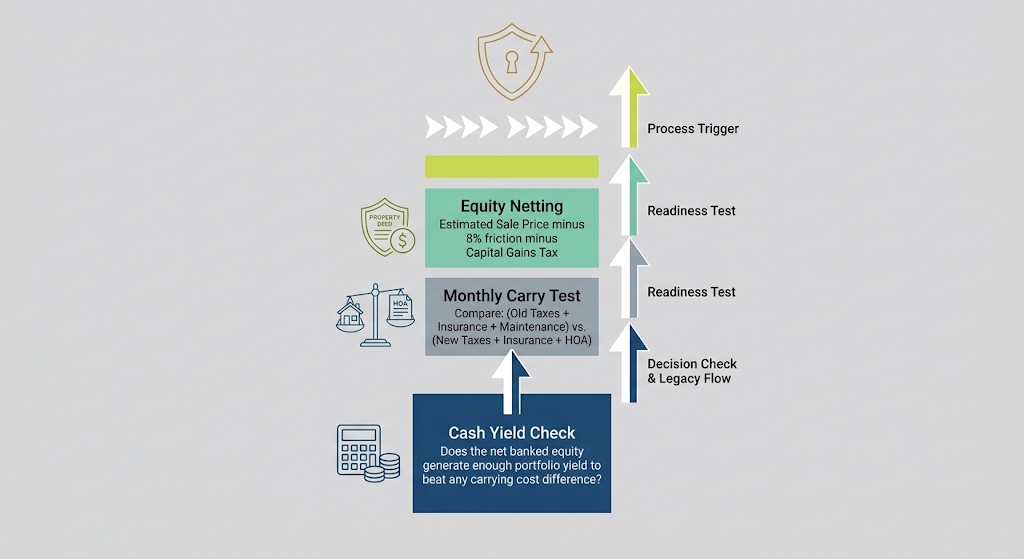
- Calculate the True Net Proceeds: Subtract 8% to 10% for sale/purchase closing friction, plus any capital gains taxes above the Section 121 limit.
- Audit the HOA’s Financial Health: Before signing a condo purchase contract, demand the Reserve Study and the last 2 years of board meeting minutes. If the reserve fund is under 70% funded, expect fee spikes or a special assessment.
- Compare Carrying Costs, Not Just Price: If your current home is paid off, compare your baseline property taxes, homeowner insurance, and annual maintenance budget directly against the new property’s taxes, HO-6 insurance, and HOA dues.
If the net proceeds from downsizing only yield $150,000 in your investment account, but your monthly carrying costs increase by $400 because of HOA dues, the move is a lifestyle choice, not a financial optimization.
Your Action Item for This Week
- Pull your property tax assessment card from your local county tax assessor website. Note your assessed taxable value versus your home’s estimated market value.
- If you are considering a move, check whether your state allows you to transfer your property tax basis to a replacement home (such as California’s Proposition 19 or Florida’s portability benefit).
- If considering a condo or townhome development, call an independent real estate agent and ask for the current monthly HOA fee history of that specific building over the last 3 years.
Next week: The Spousal Social Security Blueprint. If one spouse earned significantly more than the other, standard claiming advice completely breaks down. We audit spousal top-ups, divorced spouse benefits, and how the “deemed filing” rule dictates your strategy.